Seraphim Dispatches by WD Campbell
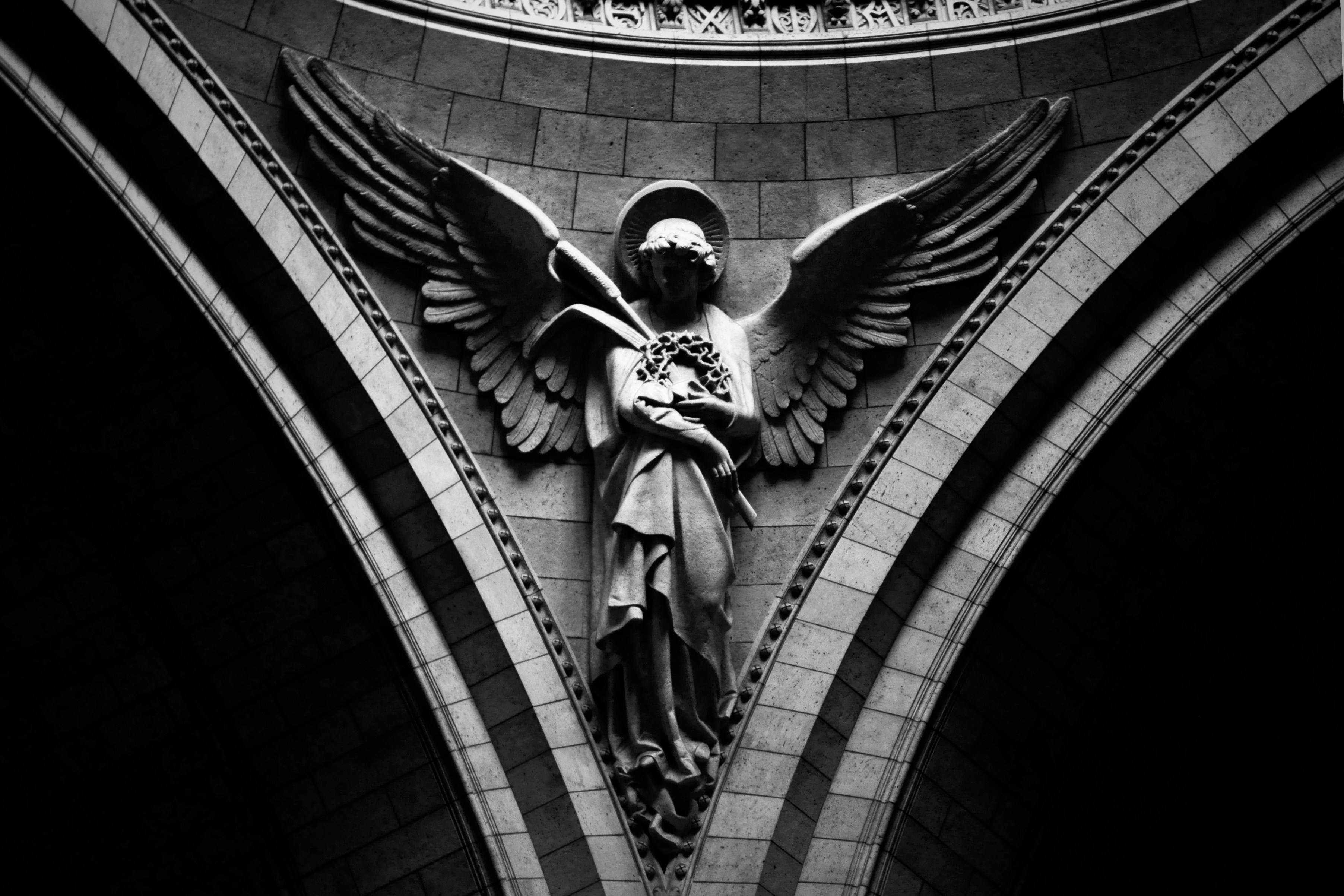
First Dispatch: “Paradise”
“Our Lord Christ begins this day to trample the nations in the winepress of His wrath.
He will rule them with a rod of iron.
And brothers... We are that Rod of Iron.”
Brigadier General Phinehas ben-Eleazar, to the 13th Benjamin Legion, on the Eve of the Triumph
Gaza City - The Holy Land. [DEI DOMINUS: +15]
“There’s two families still living in that one, we clear them out, we can take the rest down. Top floor.” He hears his section commander, Captain Ehud say in his raspy, ancient Hebrew with the weird sentence structure, rendered in his hearing into English.
He takes in the target building: five stories, a concrete block apartment, typical shitty Palestinian construction. The buildings on either side of it might have been taller, once, before Israeli bombs reduced them to slumping slag heaps. Tallest in its block, defiant, filled with fanatics tweaking on methamphetamines and generations of Jihad sermons.
He pulls up to a hover beside the fifth story window, scanning the mortar cementing the window frame into the concrete block opening. There's a weak spot, top corner, and he shoves his armoured fingers through the flimsy matrix, smashing it to powder. He grips, pulls, and his wings pull too, beating the air into submission, stabilizing him as the strength enhancements in the armour rip the window unit from its moorings, cracking glass, groaning twisted metal, but then it's gone, swinging in his fist, and he can look through the wound in the blocks into the apartment where children and women scurry and cower.
There's precious little to hide behind: thin mattresses, blankets, a scratched table, a stained electric stove. Four children, two women, barely older than girls themselves, and an old lady holding a squalling baby. They shield their faces against the dust that his wings are blasting through the new unwelcome door into their home. No screaming, except for the babe; they are hardened, these people. A man in shining white armour, six wings churning the air behind him, is not the worst thing that could come through their window. At least it's not a bomb.
The GLC-AT looms behind him, rearview warnings chiming, Beth's calm, detached voice in his ears; <"Glow-Cat is on location, can you open up that window so they can exit directly from the floor?"> General Logistics Container, Airborne Transport: a half-size shipping container with a set of seraphim wings bolted to each corner, remote controlled - fly anywhere within a 50 mile radius, load up anybody and any stuff they want to bring, carry them safely above the range of the barely aimed rifle fire to the filtration camps where there's medical and food waiting for them. He can see the marker, only one aid worker on this one, ready to coax these reluctant Palestinians out of their doomed home and into a steel box floating just outside their window. He just has to make the hole big enough.
So he grips the edges of the exposed blocks under the window sill, ripping them backward against their mortar, shearing them off, a quick glance below, there's a GLC-AT two stories down, off his right, so he pitches the blocks left, showering bits down into the shimmering feather’s vortices, trailing streams of dust.
"This building is coming down today!" he calls out: English from his lips, perfectly accented Arabic in their ears. "This area is being evacuated, by order of the High King!" He has sent enough blocks tumbling to join the dust to make the window into a door, and the GLC-AT is hovering, waiting for him to clear the fatal funnel, so he steps inside, armoured boots heavy on the floor, concrete cracking, flexing under his weight - the armour adjusts, the lowest pair of wings flapping vigorously, taking the weight of hundreds of pounds of composites and ceramics and good old fashioned steel off the groaning, cracking floor.
His visor displays the scan of the apartment's occupants. All have elevated heart rate and body temperature, but only the old woman holding the baby is filled with rage - blackness radiating out from her soul, wrapping tendrils through her chest. She's still on her feet, stepping toward him, spitting. "May pigs rape your ass in hell, filthy Jew!" Her curse hisses over grey-toothed gums. The infant girl, swaddled tight in a filthy green blanket in her arms, squirms and whines.
He ignores the crone’s curses.
His visor is outlining the threat in the hallway, beyond the thin concrete wall - a Hamas fighter: AK clutched in hands trembling with adrenaline and amphetamines, black throbbing heart a horrific tangle of hatred. The gauss rifle comes off the lug on his hip, just a hint of feedback betraying its weight to his arms, buttstock settling into his shoulder, muzzle just below the sightline. Low ready.
He knows the aid worker on the GLC-AT, there’s no mistaking Agnes' broad Yorkshire brogue beckoning and soothing the children, transmuted in hearing into soft Arabic to calm the young woman whimpering, "My baby, my baby!" Agnes, who'd been a nurse in the First World War and had seen her share of death and horrific wounds, still somehow always had a smile and a pocket full of chocolate bars in her white robes.
The Palestinians are taking their time, grabbing up blankets and clothing. He focuses on the gunman in the hallway. Hamas out there has a suicide belt on, C4 wrapped in nails. The detonator, hard to tell from the outline, might be radio-controlled. The detonator is the target, then. Smash that, takes the explosives out of the equation.
Still, he waits. When he settles on a target, decides to fire, cascading electromagnets and capacitors in concentric, spiralling rings will flash into life, accelerating the composite, hyper-layered graphene bullet to 2 km/sec. There's more than enough energy there to punch through four inches of badly mixed concrete. But inside this concrete box, the bullet ripping the air at Mach 7 will threaten lifelong hearing loss on the family currently scrambling to drag their lives into a metal box hovering outside their home.
The guy with the AK is jumpy, aiming first down the central stairwell, then spooking and spinning around at the pounding of wings overhead, or the crack of a gauss rifle nearby, or the distant blast of intercepted Israeli artillery. He's too distracted by the liquidation of Gaza City to notice the commotion from the apartment next to him.
The Palestinian family is safely in the box now, with the old woman being the last to go. Dust blasts into the dingy room from the GLC-AT's wings, it's backing away from the hole in the wall, and he tucks into the rifle, focusing on the Hamas militant's suicide belt. The rifle has no trigger- the curved part of the pistol grip where his trigger finger rests is solid- but he squeezes it anyway. The rifle fires when he wills it, thumping his shoulder, blue arc flash blinding, and the room rocks with thunder from the expanding air around the bullet's path.
The solid outline of the Hamas fighter in his visor display disintegrates, three big chunks and a spray of mist. And then his threat vector wails, rear-view camera shows the old woman shouldering past Agnes’ outstretched hand, charging him, her eyes wide and white with rage: the threat-warning is flashing << C4 - Ballbearings - wires! BOMB! BOMB! >>
Dear God, the baby...
He sees the flash, brilliant orange, an instant before his legs are thrown above his head, before fire slams through his spine, when the far wall - with the perfect little hole next to the stove - comes flying at him, smashes his visor, takes his breath, and then he's laying on his back, his legs are twisted, too far, the air is filled with dust and ricocheting ball bearings, and the ceiling is gone, it's falling in, landing somewhere behind him, and beyond it, sky. And beyond that...
Oh the radio, faintly, Ehud’s voice. “Doc! Kohl is down! Medic!”
He stares up into Paradise.
* * *
Dunroadie, Ontario. [DEI DOMINUS: -7]
When the trumpets sounded, at 2:30 am Ontario time, David Kohl missed the first half of the fanfare. He had his headphones in, winding down from his afternoon shift by scrolling videos on his phone. By the time he yanked out his earbuds, realized the swelling orchestral chorus was coming from outside, and ran to the window, the final harmonic flourishes were already sounding.
He was still peering out into the darkness when a firm knock alerted him to the bright sunlight streaming through the front door window.
He opened it to find the source of the light, a pleasant-looking, curly-haired young man in blindingly white robes.
He introduced himself as Asrahel, greeted David by name, and handed him a stack of folded white linens, explaining that David and his family were invited to a wedding. He pointed back across the street, a bit farther down where the front steps of the defunct Presbyterian church building were now glowing and golden, extending up into the night sky, beyond the clouds.
It started as a feeling, the ghost of a suspicion, as the Kohl family gathered in the front hallway, waked by the trumpets, and David passed out what Asrahel had called “wedding garments,” simple, long-sleeved white tunics richly embroidered at collar and cuff and hem with gold thread. Each member of the Kohl family found their tunic perfectly tailored. Soft, unimaginably soft, comfort enveloped him. It was so homey, so pedestrian, it began to feel unreal.
The unreality persisted, even as David and Erica herded their four children down their front steps and out to the street. Five-year-old John protested that the pavement was 'too chilly' for his bare feet, which led to David picking him up and discovering that he was smuggling his stuffed turtle inside his tunic.
Asrahel fell in beside them, arm-in-arm with sweet old Helen from the corner store. He only smiled at David, and smiled brighter at John and his 'Turtie' but somehow, when Helen had tottered up onto the golden steps of the defunct church, Asrahel was holding Turtie, and John didn't seem to mind.
The stair went through the building, which morphed around it like a covered bridge. As they began to climb the steps, Helen changed. On the first step, she was white-haired and frail: kindly old Helen. By the third step, before they reached what would have been the double doors of the old church, she was taller, straighter, with wavy auburn hair, but the same brilliant smile. All she said was "Oh my! Oh my, how lovely!" gazing at her hands, and then skipping up the steps like a spry young woman in her thirties.
The stair went upward, broad as the church steps, with no railings. The children stayed close to the centre, running up ahead of their parents, shouting their amazement as they went higher and higher. They climbed above the height of the treetops, above the power lines, above the radio towers, still upward. It should have been colder, but if anything, it was getting warmer. The stair was getting wider, and other stairs joined it, with other climbers joining before and behind them. Helen fell in with a gaggle of folks some distance ahead, and was lost to view.
The steps were broader now, taking more than one stride to cross, and across vast miles, high above the dark landscape with its streetlights and little moving headlights, there were other shining stairways, twisting, angling, climbing. The curvature of the earth was now clearly evident, with all of south-eastern Ontario to their left, the cities blobs of light against a mottled grey, and the vast blackness of Lake Ontario to their right, much farther below them than their rate of climbing, a step every few steps, should have produced.
The world turned beneath them, clustered city lights and dark bodies of water rolling fantastically fast, carrying on in its rotation far below their feet. Their stair joined another larger one, and now they were surrounded by travellers in white, shining as if in mid-day sun, walking on golden steps, thousands and thousands of people, more than he had ever seen in one place, all of them joyous, many singing, holding hands.
The Kohl family were so far from the edges of the stair that they could no longer see down, and the glimpses of the horizon between the other pilgrims showed only the vast curve of the ocean. The climb was more gradual now, every step was ten paces across, and about the time David realized that the stair had stopped going upward, and was beginning to curve itself over the horizon, miles and miles ahead, he saw it.
He heard it first: the gasps, the cries of joy, the awe-struck faltering of songs, rolling back toward them from those who had gotten further along. It was a ripple of happy surprise, and when they walked a few hundred yards further on, he saw that they were walking straight toward light on the horizon, brighter and whiter than sunrise. The dozens of distant golden ribbons curving through the sky were also converging on this light, and illuminated by it, though the sea beneath them lay in shadow.
As the multitudes marched onward, the source of the light came more and more into view. It was a stepped pyramid, with each step increasing by the same width as its height. It seemed made of diamond, or crystal, the light shining the very top, but lighting up each lower level.
Mount Zion. He knew it immediately. The New Jerusalem. The city of God. The light shining from the peak was the glory of Christ. This- this was real. David could not imagine or hallucinate something so unimaginable. He was going home.
Read the next three dispatches and the story conclusion in the full July issue. You may also enjoy the accompanying short story, The Interloper, on WD Campbell’s Substack.
